
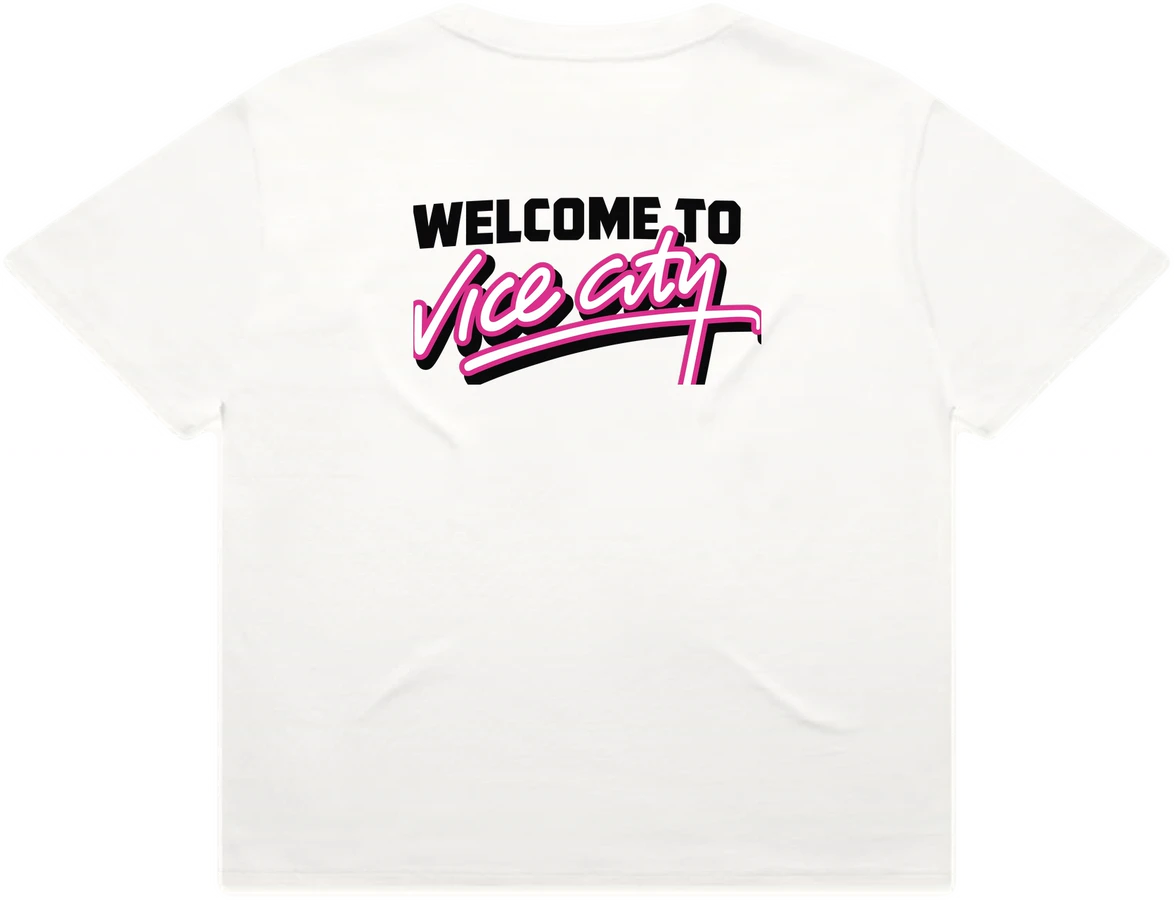
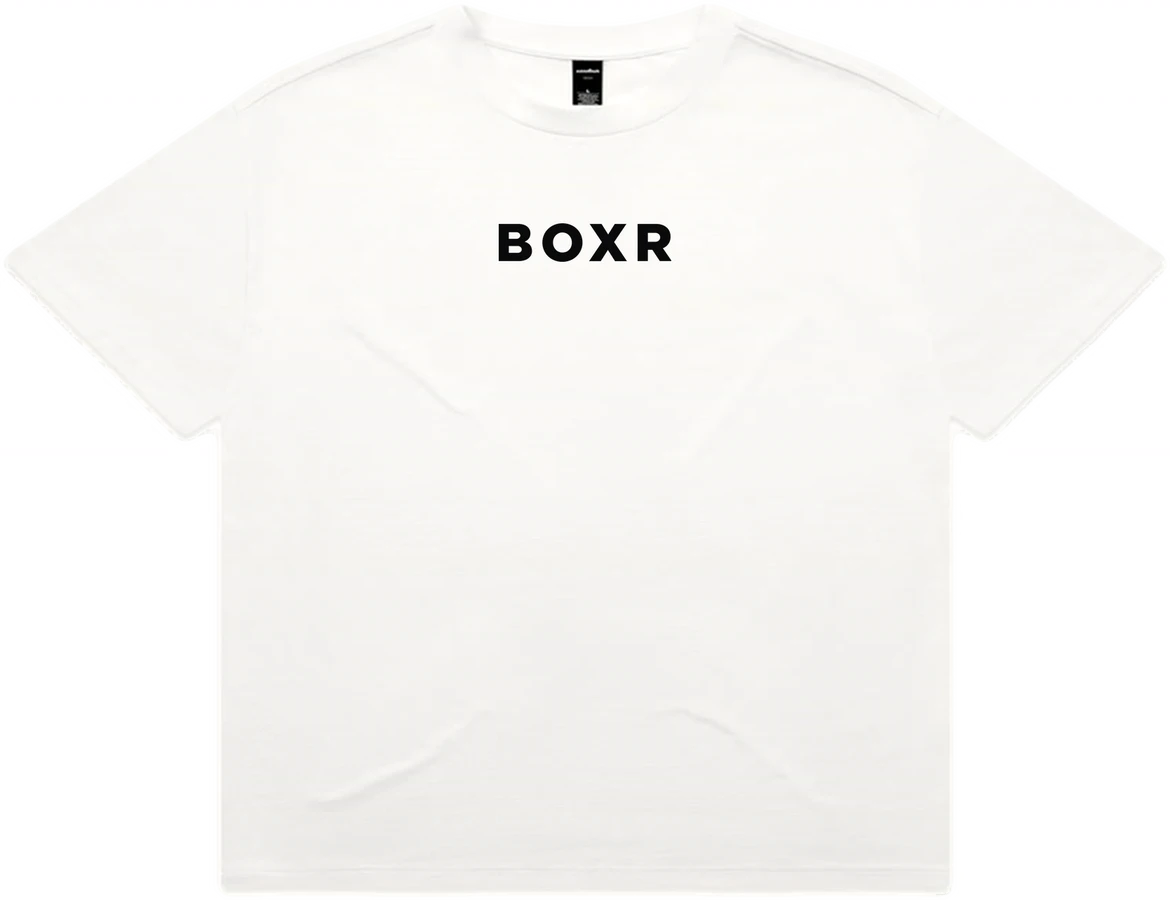
Some of the best shirts are the simplest to describe. This one is a white heavyweight tee with a small black logo on the front and a two-line statement on the back: WELCOME TO in black, and Vice City in a pink neon-style script.
Here is how the BOXR tee went from art to a finished shirt, and the decisions behind it that you can borrow for your own. BOXR is a boxing gym.
The spec sheet
- Garment: Shaka Wear SHMCS Max Heavyweight Cropped Tee, white
- Method: screen printing
- Front: BOXR wordmark in black, 6 inches, placed 3.5 inches below the collar
- Back: 12-inch print in black and pink (Pantone 225C), placed 5 inches below the collar
The ink colors flip with the shirt: white tees get black and pink, and black tees get white and pink. So each version is a 2-color back print, never 3.
Choosing the blank
The Shaka Wear SHMCS is a 7.5 oz, 100% cotton tee with a boxy cut. That weight matters for a design like this. A thick cotton tee holds its shape, drapes like streetwear instead of a giveaway shirt, and gives a big back print a flat, solid surface to sit on. It is the cropped cut of Shaka Wear's Max Heavyweight tee, so it sits a little higher on the waist.
White was the other key choice. A pink this bright looks loudest on a clean white background, and black reads sharply on it from across a room. If you like this kind of weight, our heavy streetwear rack has the SHMCS and similar blanks from AS Colour, Lane Seven and Bella+Canvas.
Why screen printing
The design is made of flat, solid colors with crisp edges, and one of those colors is a specific brand pink. That points straight at screen printing, for three reasons:
- Exact color. Screen printing is the method that can truly Pantone match, with over 2,000 colors available. The pink is mixed to 225C rather than approximated.
- Few colors. Every ink color needs its own screen, so cost depends mostly on the quantity and the number of colors. A one-color front keeps the setup simple.
- Durability at volume. Screen printing is built for runs of the same design, and the cured ink holds up wash after wash.
DTG or DTF could print the same art in full color. But both use CMYK inks, which get close to a Pantone without truly matching it. For a brand color at a screen printing quantity (24 pieces and up), screen printing is the stronger tool. Our screen printing page goes deeper.
Getting the art ready
Screen printing needs clean, high-quality art. A vector file (AI, EPS or PDF) is ideal. A PNG at 300dpi and 12 inches wide, or the actual print size, can work too. BOXR sent PNG art. Our team rebuilt it as vector art, separated the colors and prepared the final mockup for approval.
From there, the art is separated: each ink color is pulled out onto its own layer, because each one becomes its own screen. Look closely at the back and you can see why the separation matters. The Vice City script has a pink outline and a black drop shadow offset behind it. The shadow is what gives the lettering that glowing, neon-sign depth, and it has to line up exactly with the pink to work.
Placement: why 3.5 and 5 inches
Placements on this job are measured down from the collar to the top of the print. It is a reliable way to make sure every shirt, in every size, is printed in the same spot, and that a reorder matches the first run.
Front, 3.5 inches down. A 6-inch wordmark sitting high on the chest reads like a brand label rather than a graphic. It is quiet on purpose, so the back gets the attention.
Back, 5 inches down. Dropping the 12-inch print a little lower puts it across the upper back, clear of the collar, where it is easy to read when someone walks past.
Before anything is printed, these numbers show up on a digital mockup: the design on the actual garment, at the actual size and placement. Nothing goes into production until the customer signs off, and this is the stage where changing a size or a position costs nothing.
From screens to finished shirts
Once the mockup is approved and the blanks are in, the print itself follows the classic screen printing steps:
- The art is separated into one screen per ink color and print location, so the front and the back each get their own screens.
- Each screen is coated, exposed and washed out to make the stencil.
- Ink is pulled through the screens one color at a time, with each color lined up to the last.
- The shirts run through the dryer so the ink cures for good.
Screen printing typically takes 10 to 21 days from that point, and most jobs land in 10 to 14.
Checked, packed, delivered
Every order is checked against its paperwork before it leaves: count, sizes, placement and color. Then it is ready for local pickup in Miami, usually the same day it is finished, or shipped anywhere in the country.
What you can borrow from this job
- Limit your colors. Two strong colors can look more designed than six.
- Pick one exact accent. A named Pantone like 225C gives you the same pink on every reorder.
- Small front, big back. It is a layout people actually wear.
- Give placements in inches from the collar. It removes the guesswork for every size.
- Choose the blank on purpose. A heavyweight white tee does a lot of the work for a bold print.
Have a design like this?
Send us your art, the shirt you have in mind and a rough quantity, and we will tell you which method fits and send a mockup with real placements. Get a quote, or message us on WhatsApp to talk it through.
Quick answers
What shirt is the BOXR tee printed on?
A white Shaka Wear SHMCS Max Heavyweight tee in 100% cotton.
How was the pink matched?
The pink was specified as Pantone 225C. Screen printing can match Pantone colors, with over 2,000 to choose from, so the ink is mixed to that exact color.
What does 3.5 inches below the collar mean?
It is the distance from the collar down to the top of the print. Giving placements this way means every shirt in the run, and every reorder, is printed in the same spot.
Could this design be done with DTG or DTF instead?
Yes, both can print it, and they start at 6 pieces. But they use CMYK inks without true Pantone matching, so for an exact brand pink at 24 pieces or more, screen printing is the stronger choice.
How long does a job like this take?
Screen printing typically takes 10 to 21 days once the garments arrive and the mockup is approved, and most jobs land in 10 to 14 days.